
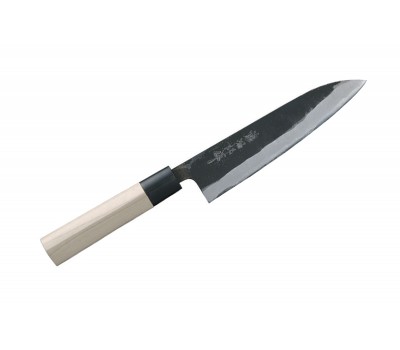
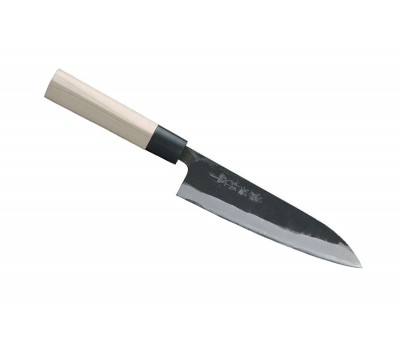
Tojiro Shirogami F-693 - Chef's knife, 3 layers, carbon steel, 180 mm blade, Japan


 |
Delivery
|
 |
Оn-line 24/7 We are available 7 days a week 24 hours a day |
 |
Shopping Protection We comply with all warranty obligations for all our products. Buying from us you can be sure of the quality of the goods! |
According to Japanese tradition, the knife was wrapped in white or blue paper. This indicated the class of goods.
Aogami - high quality, from such steel blacksmiths forged the combat blades.
Shirogami - ordinary, inexpensive steel, with excellent cutting properties.
Nowadays, this is more of a tribute to history, and Shirogami knives do a great job with all kitchen tasks, and Aogami is more of a gift option, with more value.
Choosing a lower price tag seems obvious justified, but sometimes it is necessary to get the maximum and cost is not key factor.
Most aggressive cut, in blades with a high carbon content, such as Shirogami & Aogami.
Both are very reactive, that is prone to rust. This is a significant defining moment for an informed purchase.
It's important to remember that the katana was also made of highly reactive carbon steel the Tamahagane.
When a sword of value was taken from scabbard, those present in the room held their breath so that it would rust less and before sheathing it, a corrosion-preventing treatment was carried out.
The situation is same today, high-carbon knives still exposed pitting, but cut superiorly more than stainless steel.
Gyuto is the less common name for a chef's knife.
Japanese kitchen knives, divided by specialization.
The short gyuto F-693 looks like a Santoku knife, but a bit longer.
Steel of blade is Shirogami, with excellent aggressive cut.
The blade, sharp as a razor blade, is prone to rusting and requires careful attention.
You can ignore the appearance of stains, but you can not allow rusting cutting edge.
This will lead to a loss of sharpness and the knife will need sharpening, for which it is better to use whetstones.
Other quality abrasives can be used, including diamond stones, but this should be done carefully and with understanding.
The blade are symmetric, of 3-ayered layered high carbon Shirogami steel, with quenching up to 60 HRC Rockwell and a soft steel lining with black finish.
Tojiro products are manufactured in Japan at the Fuji Cutlery Co. factory in Tsubame, Niigata Prefecture.
This is an enterprise that created and owns brand rights.
The culture of production and sophisticated technology, put the company's products at an unattainable level, in terms of price and quality.
| Knife specifications: | |
| Manufacturer: | © TOJIRO / Fujitora Industry |
| Serie: | Tojiro Shirogami Steel Series |
| Country of origin: | Japan |
| Blade steel: | Shirogami Steel (White paper) with Kurouchi descents |
| Qty. of layers: | 3 layers |
| Steel hardness: | ≈ 62 HRC on the Rockwell scale |
| Blade lenght: | 180 mm |
| Greatest blade width: | 41 mm |
| Blade thickness: | 2 mm |
| Sharpening type: | Double edge 50/50 |
| Handle lenght: | 130 mm |
| Handle material: | Magnolia wood with plastic bolster |
| Overall length: | 330 mm |
| Weight: | 125 g |
| Sterilization: | Not recommended |
Handle size is medium, conical, with a slight bulge on the right side.
The handle material, is natural magnolia wood, without impregnation, with a bolster made of durable food-grade plastic.
The tree is not impregnated, and in order to extend the service life, it is reasonable to independently impregnate the handle with linseed oil until it completely dries and polymerizes.


