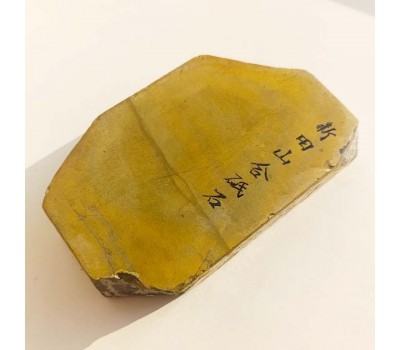
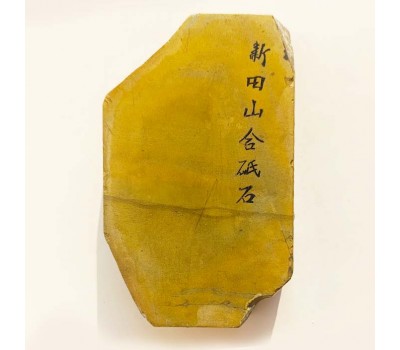
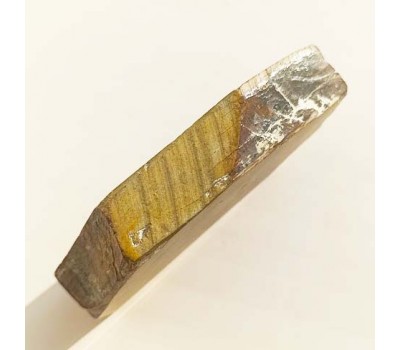
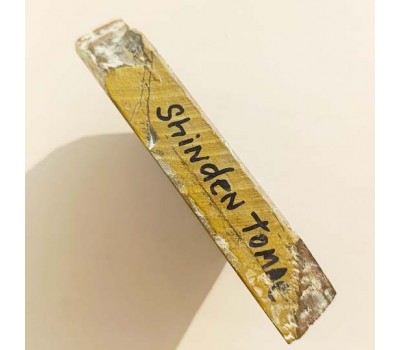
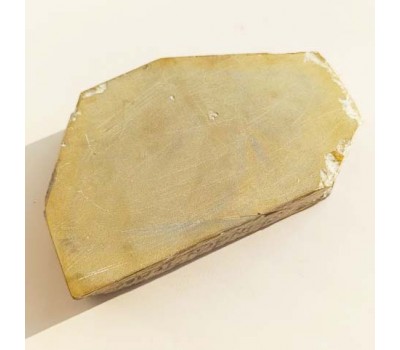
Japanese Natural Whetstone Shohonyama Shinden Tomae 745g from Kyoto Japan
![]() |
Delivery
|
![]() |
Оn-line 24/7 We are available 7 days a week 24 hours a day |

![]() |
Shopping Protection We comply with all warranty obligations for all our products. Buying from us you can be sure of the quality of the goods! |
This is a razor-sized Shohonyama Shinden Tomae stone from Kyoto, Japan. Shinden is a relatively hard natural whetstone. Beautiful gradations are visible on the surface, rare and difficult to find this size these days! Shinden can be considered the Queen of the Suite. The quality is very close to Okudo Suite and some people prefer Shinden because of its cutting ability.
Dimensions: 36-90mm × 65-145mm × 27mm (approx.)
Weight: 745g
- Grain size: very fine 8000-10000
- Nagura is not needed, but using it will definitely speed up the process
- Excellent finishing stone for knives, razors and carpentry tools.
- Hardness: 4.0
The grain size of Japanese lapping stones is quite relative, in any case it is thinner than synthetic stone # 8000. This will give the famous Kasumi coating (cloudy) and prolong the life of the blade. Finish sharpening is done on natural stones, and a smooth, sharp cutting edge is obtained. Japanese natural stones have such properties, because the quality is influenced not by the size of the abrasive particles, but by the shape. This is confirmed by a study by the University of Tokyo. SiO2 abrasive particles are in the form of rounded flakes. They do not abrade, but remove steel like sod, especially on suspension. Thus, not enough steel is removed, but the steel is also removed in such a way that an even jagged edge is not formed, which would be when sharpening on artificial stones.
Using natural stones will allow you to cut finer and at the same time extend the life of the edge. There is a good reason for this. In synthetic stones, the sharpening particles are equal in size, while in natural ones they are not. Consequently, a blade sharpened from synthetic stone will have an even height of serrated teeth, so once those teeth become dull, it will stop cutting completely, but ... when the height is different ... I think you understand my point. It's like shark teeth. They don't break right away.
Also, a natural stone sharpening has a hardening effect on the edge of the blade. This has been scientifically proven by the HRC testing machine, an experiment carried out by the renowned blacksmith Usui Kengo. In fact, the hardness was higher after polishing with a thin natural stone. As you can see, the point is not only in the achieved sharpness of natural stones. After you use natural stones, you will not want to switch to artificial ones.

-400x350.jpg)
-400x350.jpg)
-400x350.jpg)
-400x350.jpg)
-400x350.jpg)


-400x350.jpg)
-74x74.jpg)
-74x74.jpg)
-74x74.jpg)
-74x74.jpg)
-74x74.jpg)


-74x74.jpg)