When choosing a kitchen knife for daily use, an exclusive blade for a collection, an ax or a machete for rough woodwork, or a knife for hunting or outdoor use, you need to become more familiar with the materials for making blades. Such material has long been, as a rule, steel of various grades and types, the variety of properties of which will allow you to choose for yourself a high-quality tool with the necessary parameters for your preferences, whether it be a hunting blade or a Japanese kitchen knife.
Steel is an alloy of iron (at least 45%) and carbon, the amount of which mainly determines the properties of the cutting part of a knife or tool. The presence of too much carbon in the steel (more than 2.14%) will turn it into cast iron, but its lack (less than 0.5%) will lead to tin. The material located between these extreme points of manufacture is the very steel that is used for the production of kitchen and tourist knives, folding knives and multi-tools, scissors and collection blades, axes and machetes.
Steel for the production of knives can conditionally be divided into “stainless” and high-carbon.
Blades for kitchen, camping or folding knives made of high-carbon steel, most often forged. At the choice of the master making the art of knife art, such steel can be hardened or tempered to give the cutting edge of the blade hardness at the same time as elasticity. The blades of tourist, kitchen and folding knives made of high carbon steel are more susceptible to corrosion than stainless steel blades, but with proper hardening, such blades are superior in quality to stainless steel blades.
Stainless steel is very rarely forged, but some manufacturers, such as Sean Mac Williams, still create knife blades from such steel with the help of titanic labor and incredible efforts. "Stainless" steel, unlike high-carbon, has its pros and cons for the manufacture of kitchen and tourist knives, folding knives and multi-tools.
But the various properties of steel are determined not so much by the different amount of carbon in the alloy composition as by the presence of alloying impurities and additives, which determine the characteristics of blades and tools.
Carbon, as the main element of the alloy, gives the future kitchen, folding or tourist knife hardness and rigidity. The carbon content in the steel for blades for various purposes from 0.6% to 2% gives the steel the name high-carbon, which largely characterizes the properties, advantages and disadvantages of knives and blades from it.
Chrome, which is part of steel, gives the alloy wear resistance, high hardening ability and corrosion resistance, which is very important for the user of both a kitchen knife and a travel tool. Blades made of steel with a content of at least 13% chromium are commonly called "stainless", although this name contains a considerable share of craftiness. The fact is that any steel is subject to changes when exposed to an environment or aggressive environment, and your favorite kitchen, folding or tourist knife (like scissors, an ax, a machete or a multitool) will save from corroding only strict observance of the Instrument Care Rules of steel.
One of the most important elements of the alloy is manganese, which gives the material of the blades a granular structure, which, in turn, contributes to the strength of the knife or tool made of steel. It is manganese that gives a tourist or kitchen knife rigidity and wear resistance. In the production of household and professional blades, it is used to improve steel in the process of rolling and forging. Such steel for future kitchen, folding and tourist knives is called “deoxidized”. Manganese is present in almost all knife steel alloys used to produce blades.
Molybdenum is a hard-melting element, in the steel it helps it to become less brittle and brittle, and also gives the material of a kitchen, collection or tourist knife resistance to heat. The so-called "air hardened" steels contain at least 1% molybdenum, with the help of which this type of hardening of blades for kitchen, tourist and collection knives becomes possible.
In the manufacture of steel alloys, nickel is used to make objects of knife art (kitchen, tourist, folding knives, axes and machetes, multitools and scissors, tools for bonsai) to give them hardness and corrosion resistance. Nickel also gives the blade alloy a kitchen or traditional Japanese knife extra viscosity.
Silicon, as well as manganese, when forging a blade for a kitchen, folding, collection or tourist knife is used to give it a fortress.
The wear resistance of the blade of a kitchen, folding, collection or tourist knife is largely determined by the presence of tungsten steel in the alloy. When combined with a tungsten alloy with additives such as chrome or molybdenum, it makes the blade steel for a kitchen, folding, collection or tourist knife “quick-cutting”. This type of steel for blades contains the largest amount of tungsten. Steel with a high content of tungsten, in addition to the manufacture of kitchen, folding, collection or tourist knives, is used to produce armor for military equipment.
Vanadium, being a hard-melting element of increased hardness, in the composition of steel for the manufacture of kitchen, folding, collection or tourist knives, helps to increase the wear resistance and strength of the material. It is also necessary in the production of fine-grained steel for blades of knives for various purposes and steel tools.
The following is a detailed description of the popular grades of steel used to make Japanese kitchen and travel knives.
(1) Carbon steel
General characteristics - often used for traditional Japanese knives, good quality, corrosion resistant.
The Japanese company Hitachi Metals produces special cutting steels that represent the highest world standard and are used for almost all Hocho we offer. These Yasuki special steels (YSS), named after their place of origin, are made from locally produced iron ore - the same material used to make the legendary samurai swords. This steel has a very clean structure and thus provides the best achievable sharpness when cutting.
We are pleased to present the quality of steel grades for traditional Japanese knives as follows:
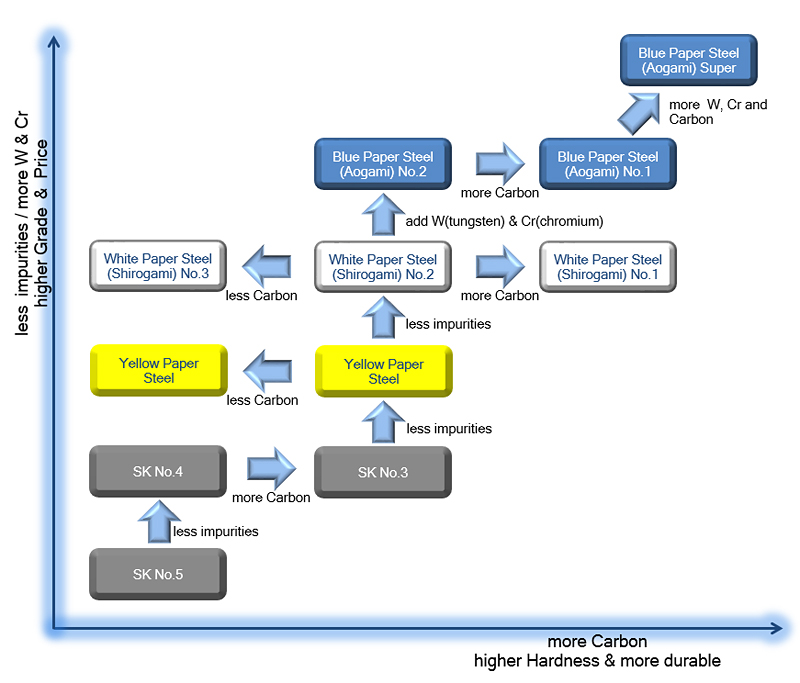
Blue steel paper (Aogami)
Hitachi high carbon steel, specially designed for tools and knives. It has the highest wear resistance and the lowest viscosity.
Very good steel, and a very popular choice for high-end Japanese Japanese knives. Many Japanese manufacturers use it. Easy to cut, very high hardness. Edge retention is outstanding. Original Japanese knives made from these materials are treated with non-aggressive, food-safe oils (like camellia oil) to prevent oxidation.
White Paper Steel (Broadsheets)
Identical to blue paper steel (Aogami), with the exception of Cr and W additives. It is a very pure carbon steel. Very popular knife steel for Japanese Japanese cutlery and especially with Honyaki type blades.
Very good edge fixation, very high working hardness. This means that you can sharpen it to exceptional sharpness, which it retains for a long time. These blades are especially suitable for the gentle preparation of products, but they are susceptible to oxidation, which leads to rust.
Yellow Paper Steel (Kigami)
Better steel compared to the SK series, but worse than Aogami and Shirogami. Used in high quality tools and kitchen knives low / middle class.
SK Steel Series
A solid performer like steel utensils. Low grade steel, mainly due to impurities. It is used mainly in hand tools such as axes, hammers and cheap kitchen knives.
Japanese Steel (Nihonko, Hagane, Virgin Carbon Steel)
An important steel that has been used to make knives in Japan since ancient times, providing better sharpness than ordinary stainless steel. Japanese steel is a high-quality steel that has an extremely high carbon content. It is produced in limited quantities in Japan. Steel is harder than German steel and has a greater sharpening potential. It also supports the edge longer than other lower carbon steel formulas. These features make Japanese steel an ideal material for the production of high-performance cutlery.
(2) Stainless steel
General Features --- Stainless steel is an alloy of iron, approximately 10 ~ 15% chromium, possibly nickel and molybdenum, with a small amount of carbon. Good stainless steel kitchen knives provide good rust resistance, ease of maintenance, good sharpness, edge retention and ease of re-sharpening. Therefore, they have become increasingly popular among novice users for professional users in this generation.
"High carbon stainless steel" usually refers to high grade stainless steel alloys with a specific amount of carbon and is designed to combine the best characteristics of carbon steel and ordinary stainless steel. High carbon stainless steel blades do not fade or stain, but withstand a sharp edge for a reasonable amount of time.
Most “high carbon” stainless blades are made of high quality alloys than the less expensive stainless steel blades, often including molybdenum, vanadium, cobalt and other components designed to increase strength, edge and cutting ability. Almost all of our stainless steel blades made of high carbon stainless steels.
Hap40
HAP40 steel is a tool high-speed powder steel from the Japanese corporation Hitachi Metals. Hardness is 64-65 HRC. High durability, good toughness, excellent sharpening retention as opposed to heavy workability and strong corrosion resistance. Because of the latter, HAP40 knives are often sold in plates of corrosion-resistant metals. Steel is not deprived of the attention of knife manufacturers. For example, Spyderco in 2015 announced the release of the Endura and Delica folders with HAP40 blades. Similar analogues: M3CL2 + Co (Japan), possibly S590 (Sweden) and CPM Rex 45 (USA).
Powder Steel R2
The chemical composition of powder steel R2 is not disclosed, it is only known that powder steel. Steel surpasses all known knife steels (including Cowry X and ZDP-189) in all main indicators - preserving the sharpness of the cutting edge, strength and resistance to rust. Manufacturer Kobe Steel Company.
Another feature of the manufacture of blades made of R2 steel is that grinders are not used to form descents, not without reason considering that they overheat the steel too. Blades are processed on a slowly rotating water stone circle. To give the blades increased strength and corrosion resistance, the blades are shackled in packages of steels of different hardness, with different carbon contents according to the "sandwich" principle. The number of layers of steel varies from manufacturer to manufacturer, but it must be taken into account that too many layers make the knife too expensive, but it doesn’t significantly improve its performance. Usually mild steels with a low carbon content and a fair amount of chromium are used (chrome gives the alloy anti-corrosion properties and increases its wear resistance). Due to the presence of dissimilar steels and a low carbon content, the plates do not perceive hardening. It is almost impossible to break such steel, just as it is impossible to break a broom made of many rods. The significant viscosity of the steel also contributes to this.
SG-2 (Super Gold No.2)
This is the more common and popular powder high-speed tool steel for knife blades. You can experience uncompromising cutting performance, excellent edge fixation and ease of maintenance (rust resistance). Made by Takefu Steel. Reaches very high hardness.
SRS-15
High Speed Tool Steel (HSS), Used in Akifusa kitchen knives and some other Japanese manufacturers. SRS-15 is very wear-resistant, fairly easy to sharpen, has an unsurpassed evil cut and holds it for incredible periods of time. Typical hardness is 63-64 HRC.
VG-1
This is a good base and ordinary Japanese stainless steel, which provides high hardness, edge retention, strength and resistance to rust. Both VG-1 and VG-10 are manufactured by Takefu Steel.
VG-10
One of the most popular and highly developed Japanese stainless steels for sharpening, edge retention and durability. Cobalt is added to special high-carbon stainless steel, which is often called "cobalt steel." Many manufacturers use VG-10 in Damascus linings.
Gingami No. 3 (Jin-san)
Fine Japanese steel company Hitachi special stainless steel, which makes similar sharpness, edge retention like carbon steel. Gingami No.3 is often used for Japanese traditional style knives
Swedish stainless steel
Pure stainless steel material from Sweden, which is well known for its excellent knife materials in the world. Selected Swedish steel is easier for processing, heat treatment and quality control. Bohler-Uddeholm stainless steel is said to be superior to Sandvik steel due to the lowest impurities for sharper and stronger knives.
Molybdenum Vanadium Stainless Steel
One of the usual and good standard, stainless steel for knives. We often recommend Molybdenum Steel kitchen knives for first-time users and novice users of Japanese knives for their characteristics. Easy to re-sharpen, good durability and resistance to rust, and a reasonable price range.
[General Features] ISEYA I series feature 33 layers of Damascus-Hammered(Tsuchime) texture blad..
Chromax steel is a new knife steel that has excellent properties for kitchen knives. This is a semi ..
Deba Knife - thick and heavy bladed knife so they do not bend easily, Often used for cutting fish an..
Elite high quality, high carbon stainless steel. ATS-34. Gyuto is the Japanese version of the classi..


-700x700.jpg)
-700x700.jpg)
-700x700.jpg)
-700x700.jpg)
-700x700.jpg)
-700x700.jpg)
-700x700.jpg)