
Japanese Natural Whetstone Yaginoshima Suita 1760g from Kyoto





- Availability: In Stock
- Product Code: Yaginoshima Suita 1760g
 |
Delivery
|
 |
Оn-line 24/7 We are available 7 days a week 24 hours a day |
 |
Shopping Protection We comply with all warranty obligations for all our products. Buying from us you can be sure of the quality of the goods! |
This is a Shōhonyama Yaginoshima Suita from Kyoto, designed for the final finishing of kitchen knives and traditional woodworking tools.
Yaginoshima (八木ノ嶋) is a historic sharpening stone mine located east of Ohira and is well known for producing exceptionally high-quality Suita stones.
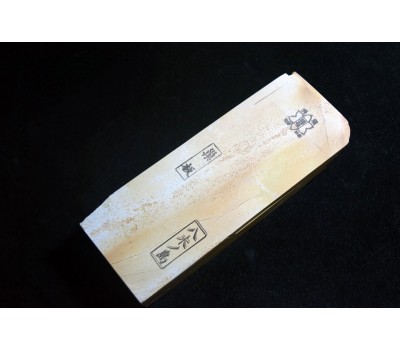
The natural lines visible on the sharpening surface are Kesuji (harmless natural lines), not Suji (toxic lines). They do not interfere with sharpening in any way.
With its medium hardness, this stone offers excellent control and consistently produces an exceptionally refined cutting edge. It has high abrasive performance, allowing steel to be removed quickly while maintaining excellent edge quality.
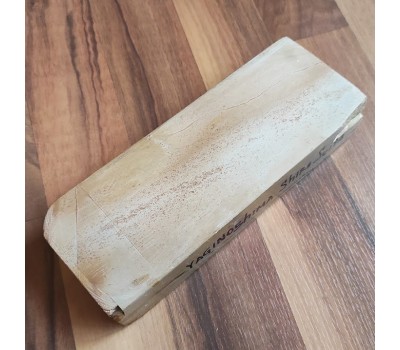
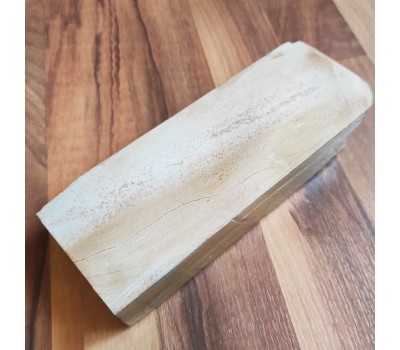
All surfaces except the working face have been sealed with lacquer. The sharpening surface has been professionally lapped and is ready for immediate use (see the last two photographs).
Specifications
Dimensions: Approximately 80 × 211 × 40 mm
Weight: Approximately 1,760 g
Estimated Grit: 6,000–8,000
Hardness: 4.0
Nagura: Not required, although using a Nagura stone will significantly speed up slurry development.
Recommended for: Kitchen knives and traditional woodworking tools.
Kanji and Stamps
Flower-shaped stamp – Kyoto Natural Honyama Stone Association.
巣板 (Suita) – Suita.
八木ノ嶋 (Yaginoshima) – Yaginoshima Mine.
About Japanese Natural Finishing Stones
The grit rating of Japanese natural finishing stones is only an approximation. In practice, this stone produces a finish finer than a synthetic #8,000 stone while creating the highly desirable Kasumi (misty) finish and helping to extend the service life of the cutting edge.
Natural finishing stones produce an exceptionally smooth, sharp, and refined edge because their performance depends not only on particle size but also on the shape of the abrasive particles.
Research conducted by the University of Tokyo has shown that the silica (SiO₂) abrasive particles found in Japanese natural stones are composed of tiny rounded, plate-like structures. Rather than simply scratching the steel like synthetic abrasives, they shear and lift extremely thin layers of metal, especially when working with a slurry. As a result, very little steel is removed while producing a cleaner, more refined edge without the uniform saw-tooth pattern typically created by synthetic stones.
Using a natural finishing stone allows a knife to make cleaner, smoother cuts while also improving edge retention. One reason is that synthetic stones contain abrasive particles of nearly identical size, creating micro-serrations of equal height. Once those teeth become worn, cutting performance drops rapidly. Natural stones, however, contain abrasives of varying sizes, producing micro-serrations of different heights. As the larger teeth wear away, the smaller ones continue cutting, much like the teeth of a shark, resulting in a longer-lasting edge.
Natural finishing stones may also produce a slight work-hardening effect on the very apex of the cutting edge. This phenomenon has been reported in experiments performed by renowned Japanese bladesmith Usui Kengo, who measured a small increase in surface hardness after polishing with fine natural stones using HRC testing equipment.
The appeal of Japanese natural stones goes far beyond the exceptional sharpness they produce. Once you experience the cutting performance and edge quality they deliver, many users find it difficult to return to synthetic sharpening stones.

